
More sources than the wall can hold

Broadcast Multiviewer Solutions for Modern Control Rooms
Modern broadcast production generates more video sources than traditional monitor walls can accommodate. Fixed hardware setups create bottlenecks when adding cameras, feeds, and IP streams, forcing expensive infrastructure upgrades. A broadcast multiviewer eliminates these constraints by consolidating unlimited sources onto a single, flexible display canvas.
VuWall TRx delivers enterprise-grade multiviewer capabilities that integrate SDI feeds, IP streams, encoders, replay machines, graphics, and web dashboards in one unified interface. Operators gain real-time visibility across all sources without rewiring hardware, while the software-based architecture scales instantly as production needs evolve. This approach reduces capital expenditure on physical equipment while improving operational efficiency in demanding live production environments.
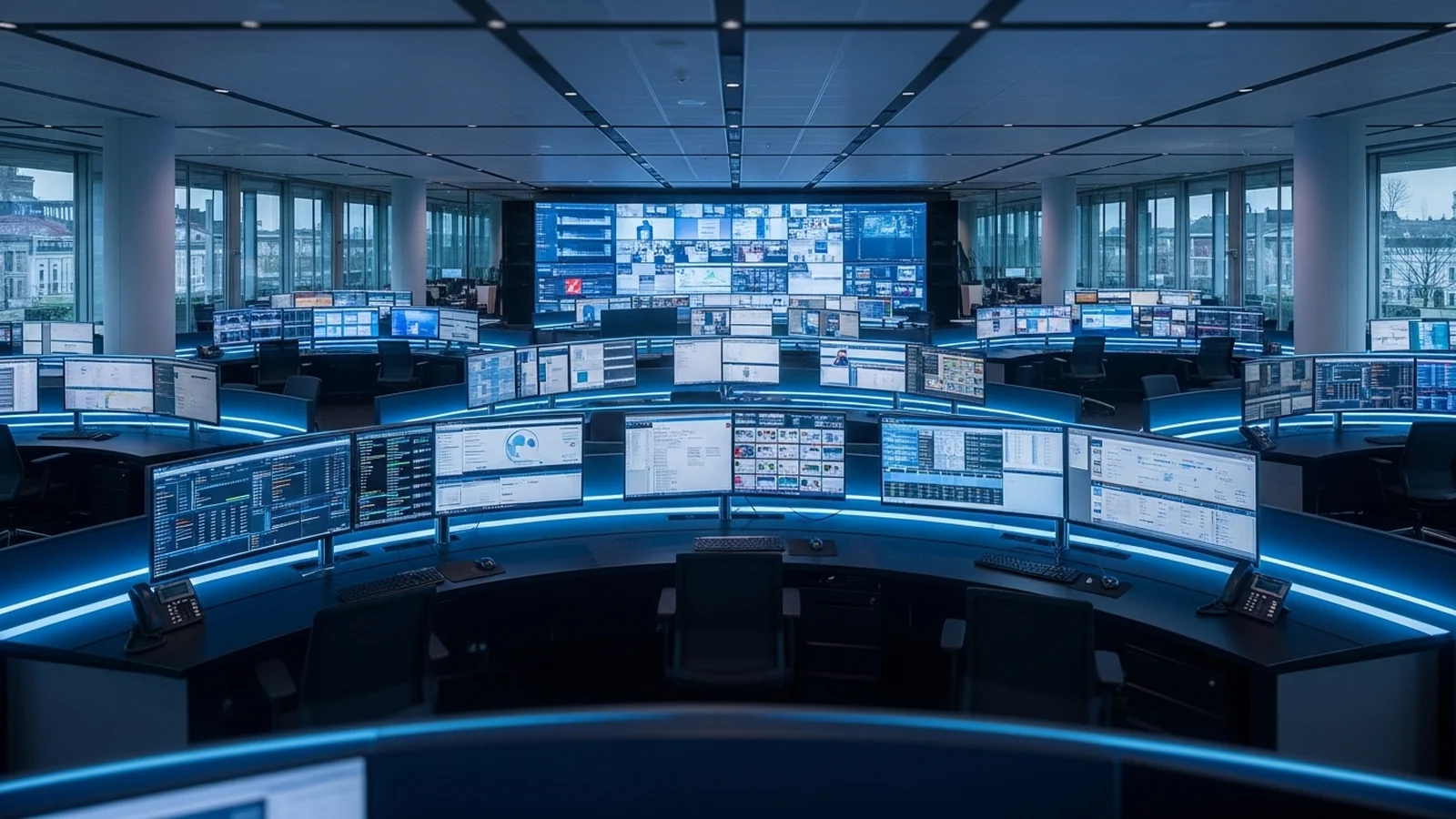
A broadcast control room used to mean a wall of monitors. One display per source, hard-wired, fixed in place. Add a camera, add a feed, find room for another screen. A live production today runs more sources than any monitor wall can hold.
A multiviewer changes the model. VuWall TRx puts every source on one canvas. Cameras, SDI feeds, IP streams, encoders, replay machines, graphics, a web dashboard. Drag any of them to any window, resize, reposition. The operator stops counting monitors and starts watching the show.
A broadcast multiviewer displays many video sources as resizable windows on one screen or canvas, rather than giving each source its own fixed monitor. VuWall TRx configures multiviewers, video walls, encoders and decoders from one platform. Operators place SDI feeds, IP streams, encoders, applications and web sources in any window by drag and drop, resize or crop them, and rebuild the layout for the next segment.
More sources than the wall can hold
A modern live production has no shortage of things to watch. Programme and preview, every camera, replay channels, incoming feeds, graphics, clocks, audio meters, comms status and a web dashboard or two. A fixed monitor wall answers each by adding a screen and a cable run, until the room runs out of both. A multiviewer answers by adding a window. The operator places any source anywhere on the canvas, sizes the important feeds larger, and clears the rest.
Why the architecture matters on live air
A production gallery cannot pause for a reboot mid-show. That raises the cost of a single point of failure. TRx builds the canvas on VuWall PAK nodes, where each PAK is a networked decode node that runs standalone or stitches with others. No central processor drives every window, so one node dropping out costs the windows on that node rather than the whole canvas. Adding capacity means stitching another node, not swapping the platform.
Seeing a feed is not controlling it
A reference wall shows you a feed. It does not let you touch the machine behind it. G&D and VuWall close that gap with VisionVS, a dual-encoding appliance. VisionVS captures a KVM source and sends it two ways at once: a G&D bluedec stream to the G&D KVM matrix, and a VuWall stream to the PAK processors for the video wall, an operator station or remote access. The operator sees the source on the canvas and takes keyboard and mouse control of it from the same desk. The TRx management platform is SOC 2 Type II compliant.
- [1]Any source on one canvas: SDI, HDMI, DP, IP streams, encoders, applications and web sources, by drag and drop
- [2]Multiviewer and video wall in one: configure both, plus encoders and decoders, from a single TRx interface
- [3]Node-based scaling: 32 HD streams and up to two 4K outputs per PAK, stitch nodes to carry 50 feeds or more
- [4]No single point of failure: one node failing drops its windows, not the whole canvas
- [5]KVM on the canvas: VisionVS pairs the picture with keyboard and mouse control of the machine behind it
The right question for a monitoring wall
Pixel count sells walls, but it rarely limits a gallery. The limit is how many sources an operator can see at once, how easily the layout changes between segments, what happens to the picture when one box fails, and whether seeing a source also means controlling it. A unified, node-based canvas with KVM built in answers all four with one architecture.
Frequently asked questions
A broadcast multiviewer is a system that displays many video sources as resizable windows on one screen or canvas, instead of giving each source its own fixed monitor. VuWall TRx configures multiviewers, video walls, encoders and decoders from one platform. Operators place SDI feeds, IP streams, encoders, applications and web sources in any window by drag and drop, resize or reposition them, and rebuild the layout for the next segment.
A reference monitor farm, or monitor wall, is a fixed array of dedicated displays in a control room, traditionally one monitor hard-wired per source for confidence monitoring. Broadcasters replace it because a live production now runs more sources than a fixed wall can hold, and every new feed needs another screen and another cable run. A multiviewer canvas places any source in any window from software, so capacity grows by adding a window rather than a monitor.
Capacity scales with the number of PAK nodes. Each VuWall PAK decodes up to 32 HD streams and drives up to four HD outputs or two 4K outputs. PAK nodes stitch together to build larger canvases, so a multiviewer can pass 50 simultaneous feeds or more by adding nodes rather than replacing the platform. PAK supports SDI, HDMI, DisplayPort and IP sources, plus open-standard codecs such as H.264 and H.265.
VuWall PAK nodes work independently from one another. If a single PAK node fails, only the displays or windows driven by that node are affected, while the rest of the system keeps running. There is no central processor whose failure blacks out the whole canvas. For live production, that means a fault costs a corner of the wall rather than the entire room.
VisionVS is a dual-encoding appliance from G&D and VuWall that combines KVM control with video wall visualisation. It captures a KVM source and sends it two ways at once: a G&D bluedec stream to the G&D KVM matrix, and a VuWall stream to the PAK processors for the video wall, an operator station or remote access. The operator sees the source on the canvas and takes keyboard and mouse control of the machine behind it from the same desk.
The TRx management platform is SOC 2 Type II compliant, meaning its information security practices, policies and operations have been independently audited and validated. G&D’s KVM-over-IP line that pairs with VuWall in broadcast workflows carries certifications including Common Criteria EAL2+, FIPS 140-3 and DODIN APL. Security posture should always be matched to the specific deployment and threat model.
Enova Technologies is a VuWall and G&D partner in Singapore. Contact us to discuss a multiviewer canvas for your production gallery, master control room, or OB setup.
Ask us about TRx and VisionVS
Published by
eNOVA Technologies is Singapore's specialist distributor for data centre IT management solutions, representing Adder, Guntermann & Drunck, Raritan, Sunbird, ZPE Systems, and VuWall across Singapore and Southeast Asia. Our technical content is produced with AI assistance and reviewed by our in-house team before publication.
This article was produced with AI assistance and reviewed by the eNOVA Technologies team. All technical claims are verified against manufacturer documentation.