

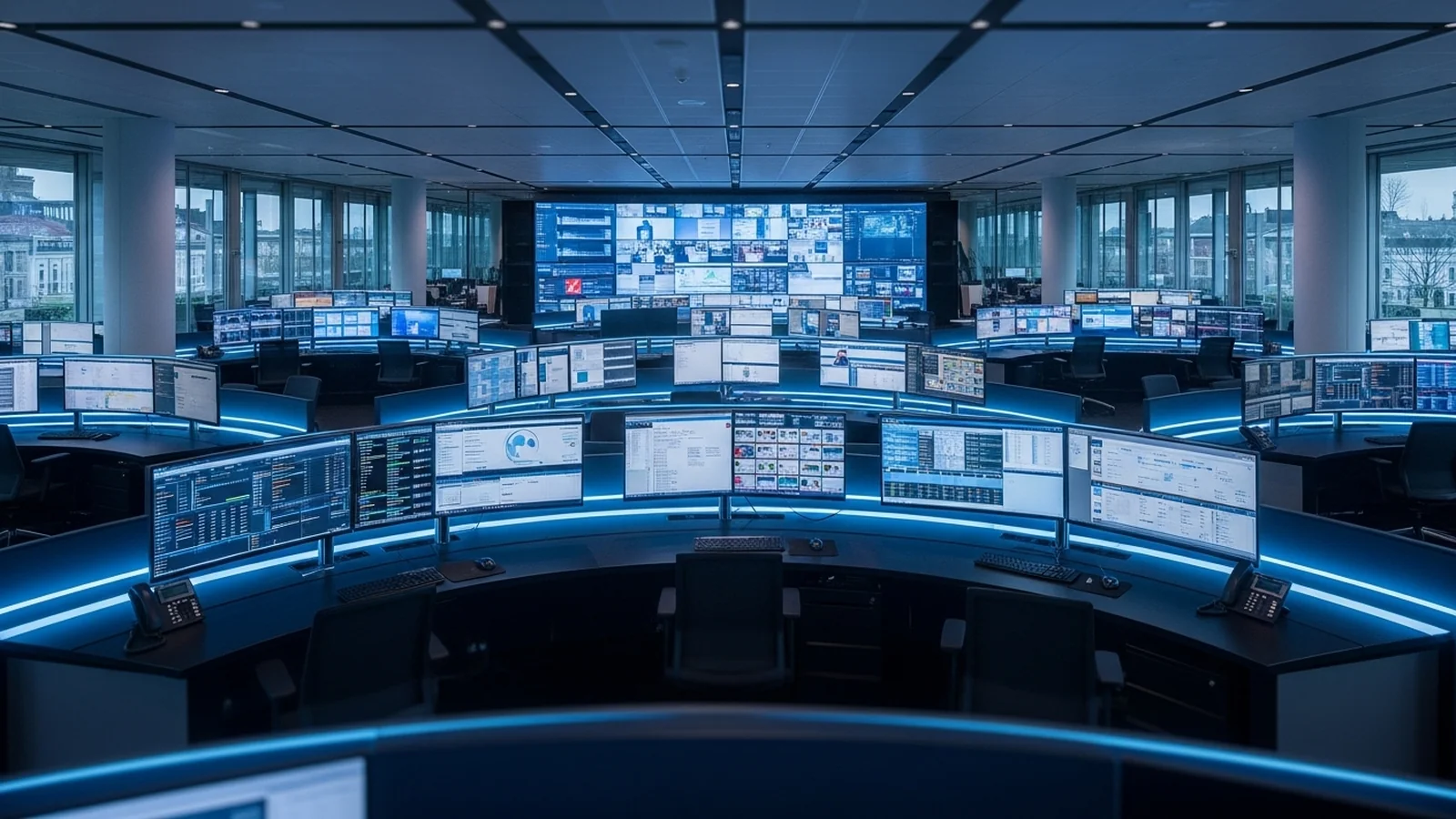
Designing emergency response control rooms: lessons from the Wetteraukreis dispatch centre

Emergency Dispatch Control Room Design Best Practices
During major incidents, emergency dispatchers juggle multiple systems simultaneously while managing critical communications. Without unified, resilient infrastructure, operational inefficiencies and delayed response times can cost lives. Modern emergency response control rooms require robust technology design that keeps all systems synchronized and accessible under extreme pressure.
The Wetteraukreis dispatch centre demonstrates how centralized control room design enhances operator efficiency across 51+ workstations. By consolidating 53 source computers behind a single interface with redundant failover systems, dispatchers access critical data faster and maintain continuous operations even during system failures. This architectural approach ensures every communication channel, camera feed, and data stream remains available when seconds matter most.
Designing emergency response control rooms: lessons from the Wetteraukreis dispatch centre
A dispatcher on a live incident works several systems at once. The Wetteraukreis emergency centre in Germany put all of them, 51 operator desks and 53 source computers, behind one interface, and gave every layer a fallback.
Picture the dispatch desk during a large incident. Calls are coming in. Camera feeds show the scene. A map overlay tracks the crews. Radio traffic runs alongside. VuWall uses this exact scenario to make its case for integrated control rooms.
The problem is rarely the number of sources. It is how many separate systems sit between the operator and those sources. A KVM switch for the computers, a video wall processor for the big screens, a recording system, an AV-over-IP layer, each with its own controls. VuWall’s point is that many control rooms still run them separately, which means more transmitters per source and more cost, and an operator who spends the incident moving between tools.
What an integrated control room platform is
An integrated control room platform manages KVM switching, AV-over-IP distribution and video wall layouts from a single software layer. Any source, whether a physical computer, a virtual machine, a camera or a web dashboard, can be routed to any operator desk or any wall from the same interface, under one set of user rights.
The practical effect is that the operator learns one system. Moving a camera feed to the wall, taking control of a source computer and changing a layout are the same kind of action in the same place.
The Wetteraukreis Central Control Center
Wetteraukreis is a district in Hesse, north of Frankfurt. Its Central Control Center in Friedberg coordinates fire, rescue and civil protection services for about 310,000 residents across roughly 1,100 km².
According to integrator Qvest, the existing infrastructure had reached its limits for emergency call acceptance, alerting and communication handling. VuWall describes the old AV system as having limited video distribution, little flexibility and a fragmented control environment.
Qvest rebuilt the centre with VuWall. Mission control stations, meeting rooms and the command centre now sit on one central media control system. VuWall TRx is the command hub for the video walls and the KVM sources, and operators work it through HTML5 interfaces.
| Operator workstations | 51, on redundant IP-KVM extenders over fibre |
| Source computers | 53 computer modules, also redundant, plus two virtual KVM gateways for virtual machines |
| Video | Up to 4K at 60 Hz. 4K 4:4:4 at 8-bit runs up to 300 m over the existing multimode fibre |
| Control | HTML5 interfaces through VuWall TRx, with ControlVu touch panels as a fallback layer |
| Network | Four Netgear M4300-96X switches stacked as one Layer 3 network, six 40G stacking ports each, redundant power |
| Segmentation | Firewall between the control network and the AV network |
| Integrator | Qvest GmbH |
Four design choices worth copying
One interface for desk and wall
Operators route sources to their own screens and to the video walls from the same interface. There is no second system to learn, and no second login to find during an incident. The same applies to virtual sources: the two virtual KVM gateways bring virtual machines onto the same desks as the physical computers.
A fallback that does not need the main interface
Qvest describes the touch panel as a fallback layer. If the primary interface is unavailable, operators still have a simple, separate way to switch sources and change layouts. In a room that cannot stop, the question is not whether the main interface will ever fail. It is what the operator does in the minute after it does.
A network that rides out a switch failure
The four Netgear switches run as one stack, with redundant power supplies in each. Qvest states that the rest of the system keeps working through the complete failure of one switch. The KVM extenders themselves are redundant on both the workstation and the computer side.
Control traffic kept apart from AV traffic
A WatchGuard firewall separates the control network from the AV network. Teams in utilities and manufacturing already segment their networks into zones for exactly this reason. The same discipline belongs in the control room AV design, not only in the plant network.
The same approach at larger scale
VuWall’s second public safety reference is an agency that coordinates fire services, emergency responders, law enforcement and public transport. The scale is larger: 11 video walls in 8×2 layouts, 60 displays, dozens of desktop monitors and hundreds of VuStream 150 encoders, with output up to 8K and remote access from off-site.
The integration point here is video management. The agency already ran Genetec, and VuWall’s Genetec plugin lets operators control both the cameras and the video walls from inside that one application. Content windows on the walls can be resized, moved or prioritised as an incident develops. TRx carries the same plugin approach for Milestone XProtect.
What carries over to industrial and utility control rooms
A utility outage room, a plant operations centre and a transport control room share the dispatcher’s problem. Many sources, a small number of operators, and no time to switch between systems when something goes wrong.
Ask at design stage
Can an operator put any source on any screen from one place? What happens when the main interface fails? What happens when a core switch fails? Is the AV network separated from the control network?
What to bring to the conversation
The number of sources, including virtual machines and cameras. The number of operator positions. The wall and display layout. Which video management system, if any, the room already uses.
What the case studies do not say. Neither VuWall nor Qvest publishes response-time results, a go-live date or project costs for Wetteraukreis, and Qvest does not name the KVM vendor. The coordination agency is not named in VuWall’s text. VuWall’s 2025 blog on emergency control rooms cites research on operator task switching that we could not trace to a primary source, so we have not repeated those figures.
Frequently asked questions
What makes an emergency response control room different from other control rooms?
It runs around the clock, its operators handle several sources at once during an incident, and it cannot stop for maintenance or a failed component. That puts the weight of the design on two things: how quickly an operator can bring the right source in front of them, and what still works when part of the system fails.
What did the Wetteraukreis control centre install?
According to VuWall and integrator Qvest, the centre in Friedberg, Germany, runs VuWall TRx as the command hub for its video walls and KVM sources. 51 operator workstations reach 53 source computers over a redundant IP-KVM system at up to 4K/60, with two virtual KVM gateways, ControlVu touch panels as a fallback, and four stacked Netgear M4300-96X switches.
Why combine KVM and video wall control in one platform?
When KVM, AV-over-IP and video wall management are separate systems, each source tends to need several transmitters, costs rise, and operators switch between tools during an incident. A single platform gives one interface and one set of user rights for every source, desk and wall.
How should a control room handle failure of the main control interface?
Give operators a separate fallback. At Wetteraukreis, ControlVu touch panels act as a fallback layer so operators can still switch sources and change layouts if the main interface is unavailable. Combine this with a redundant network, so a single failed switch does not take the room down.
Can VuWall TRx work with an existing video management system?
Yes. VuWall offers plugins for Genetec Security Center and Milestone XProtect, so operators can control cameras and video walls from inside the VMS they already use. One of VuWall’s public safety references runs 11 video walls and 60 displays this way through the Genetec plugin.
Does this design apply to industrial and utility control rooms?
Yes. Outage rooms, plant operations centres and transport control rooms have the same pattern of many sources and few operators. The same design questions apply: one interface for every source and screen, a fallback when the main interface fails, a network that survives a switch failure, and separation between the control network and the AV network.
Planning or refreshing a control room
Enova Technologies is an authorised VuWall partner in Singapore. Send us the source count, the operator positions and the display layout, and we will map your room against the design choices above.
Review my control roomSources: VuWall, Faster, Smarter, Safer: Wetteraukreis’ Emergency Center Powered by VuWall. Qvest, Renewal of the Central Control Center in Wetteraukreis. VuWall, VuWall Powers Public Safety and Security Coordination Agency. VuWall blog, From Dispatch to Decision: Designing Smarter Control Rooms for Emergency Response, 13 August 2025. Product details from the VuWall TRx product page.

Published by
eNOVA Technologies is Singapore's specialist distributor for data centre IT management solutions, representing Adder, Guntermann & Drunck, Raritan, Sunbird, ZPE Systems, and VuWall across Singapore and Southeast Asia. Our technical content is produced with AI assistance and reviewed by our in-house team before publication.
This article was produced with AI assistance and reviewed by the eNOVA Technologies team. All technical claims are verified against manufacturer documentation.