



Liquid Cooling Documentation Gap Threatens Data Center Capacity Planning


Liquid Cooling Documentation Gap in Data Centers
As liquid-cooled GPU clusters become standard infrastructure, data centers face a critical blind spot: cooling loops lack the rigorous documentation that power chains enjoy. This documentation gap creates blind spots in capacity planning, making it impossible to model thermal load distribution, predict failure cascades, or execute safe maintenance procedures when high-density equipment arrives.
Proper liquid cooling documentation establishes parent-child relationships across your thermal infrastructure—from facility chiller to loop manifold to individual server connections—mirroring the hierarchical accountability that powers capacity planning and change management. Without this structure, data centers cannot accurately forecast thermal headroom, simulate growth scenarios, or trace impact across dependent systems before deploying next-generation compute.
Sunbird DCIM | dcTrack 9.3.5
Your power chain is documented link by link. Your cooling loop probably is not. That gap stops being academic the moment a liquid-cooled GPU cluster lands.
Most data centres model power properly. Branch circuit to rack PDU to outlet to server power supply, with a parent and a child at every step. That structure is what makes capacity planning, change management and impact analysis work at all. Ask which racks drop if a breaker trips, and the answer comes out of the system.
Then a liquid-cooled cluster arrives. It brings a coolant distribution unit, a rack manifold, and either cold plates on the chips or a door heat exchanger on the cabinet. That is a second dependency chain feeding the same servers. In most DCIM tools there is no object type for any of it, so it ends up in a note, a spreadsheet, or somebody’s head.
What is a rack manifold? A rack manifold is the vertical distribution pipe inside or alongside a cabinet that splits coolant from a single supply into individual branches, one per server, and collects the warmed return. It does for liquid what a rack PDU does for power. A coolant distribution unit, or CDU, sits upstream of it: the CDU isolates the facility water loop from the technology loop feeding the racks, and controls flow, pressure and temperature to the equipment. Manifold and CDU together form the cooling equivalent of the power chain, which is why leaving them out of the asset model leaves a gap in capacity and impact analysis.
Why this matters in Singapore right now
Singapore’s Green Data Centre Roadmap, published on 30 May 2024, sets a target Power Usage Effectiveness of 1.3 at full IT load and introduced standards covering IT equipment energy efficiency and liquid cooling. New capacity has been released towards the more efficient projects. Liquid cooling is one of the routes operators take to reach those numbers, particularly in a climate with no cool season to fall back on.
At the same time, capacity forecasting is getting harder. The Uptime Institute Global Data Center Survey 2026 found that 76% of data centre managers and operators are at least somewhat concerned about forecasting future capacity requirements, up from 68% in 2024. Adding an undocumented second dependency chain to that picture does not help.
[1] POWER CHAIN: MODELLED
Questions the system already answers:
- What drops if this breaker trips?
- How much headroom is on this circuit?
- Which servers sit on a single feed?
- Can this cabinet take four more nodes?
[2] COOLING CHAIN: USUALLY NOT
Questions that go to a person instead:
- Which racks lose cooling if this CDU is serviced?
- How many ports are left on this manifold?
- Which GPU nodes are liquid cooled, which still air?
- Does this hall have loop capacity for the next cluster?
What dcTrack 9.3.5 changes
Sunbird released dcTrack 9.3.5 on 6 July 2026. The headline item is liquid cooling infrastructure. You can create, place, track and model CDUs and manifolds as assets, the same way you already handle a rack PDU.
It also covers the awkward cases. Door heat exchangers and direct-to-chip cooling have no ports and no connections in the sense a structured cabling model expects, so they never fitted the data model cleanly. dcTrack 9.3.5 manages them as assets with relationships, which is what makes impact analysis on a liquid cooling deployment possible rather than notional.
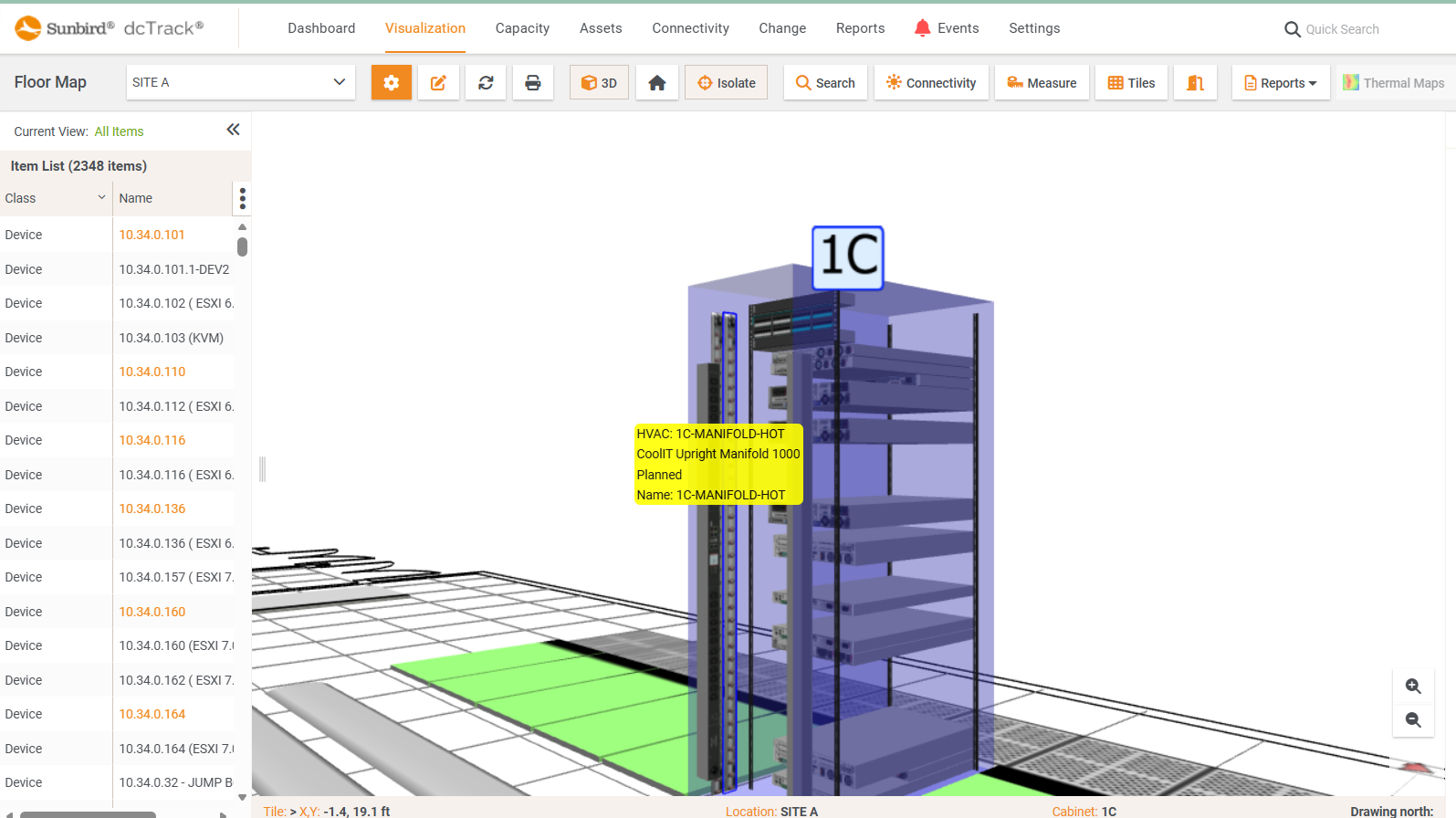
| [1] | CDUs and manifolds as real assets. Create, place, track and model them, with the placement and relationship handling already used for power equipment. |
| [2] | Door heat exchangers and direct-to-chip cooling. Asset and relationship management for equipment with no ports and no connections, which is exactly where the older data model gave up. |
| [3] | Visibility into liquid-cooled compute. See which GPUs and supporting infrastructure sit on which loop, then plan, manage and run impact analysis against it. |
| [4] | Granular dashboard permissions for local users. Restricted users can open dashboards and see filtered chart widget data covering only the locations and items they are authorised to view. |
| [5] | Three ServiceNow connector enhancements. Mapped fields sync bidirectionally on first item integration, ServiceNow filtering now runs as the first step of the sync so unqualified assets drop out early, and field mappings defined on a parent class are applied automatically to child classes. |
The release carries a longer list of smaller changes as well: list view export to Excel with automatic column formatting, business rules for tickets and projects, connector integration errors surfaced in the Events tab, bulk import and export of custom field definitions, bulk import of branch circuit breaker derating, support for powered dry contact, motion, tamper and vibration sensors, a readings subtab for integrated UPSs, and an executive dashboard folder.
“Create, place, track and model liquid cooling infrastructure such as coolant distribution units (CDUs) and manifolds.”
Sunbird Software, dcTrack 9.3.5 release note, 6 July 2026Two things worth being clear about
This is documentation and planning, not control. dcTrack models the cooling chain and tells you what depends on what. It does not operate a CDU and it does not replace a building management system.
The benefit only appears once the manifold and CDU records are actually in the system. That is data entry before it is insight, and it costs far less at the pilot-rack stage than after the third cluster has landed.
Where to start if liquid cooling is on your roadmap
Record the cooling chain at the same time as the hardware arrives, not afterwards. One CDU, its manifolds, and the racks they serve is a small enough job to do properly in an afternoon. Retrofitting the same records across three halls a year later is the version nobody volunteers for.
Treat loop capacity as a capacity metric alongside kW and rack units. If a hall is power-rich and loop-poor, that is worth knowing before the purchase order, not during commissioning.
Frequently asked questions
What is new in Sunbird dcTrack 9.3.5?
dcTrack 9.3.5, released on 6 July 2026, adds tracking and modelling of liquid cooling infrastructure including coolant distribution units and manifolds, improved asset and relationship management for door heat exchangers and direct-to-chip cooling, granular dashboard permissions for local users, and three enhancements to the certified ServiceNow connector. It also includes Excel list view export with automatic column formatting, business rules for tickets and projects, bulk import of branch circuit breaker derating, and support for powered dry contact, motion, tamper and vibration sensors.
What is the difference between a CDU and a rack manifold?
A coolant distribution unit isolates the facility water loop from the technology loop that feeds IT equipment, and controls the flow, pressure and temperature delivered to the racks. A rack manifold sits downstream of the CDU and splits that supply into individual branches, one per server, then collects the warmed return. In asset terms the CDU is the upstream source and the manifold is the in-rack distribution point, roughly the relationship a branch circuit has with a rack PDU.
Why do door heat exchangers and direct-to-chip cooling cause problems for DCIM?
DCIM data models are built around ports and connections, because that is how power and network equipment behaves. A door heat exchanger or a direct-to-chip cold plate has neither, so there is nothing for the model to attach to and the equipment tends to be recorded as a generic asset or not at all. dcTrack 9.3.5 handles these as assets with relationships instead, which preserves the dependency information needed for impact analysis.
Does dcTrack control liquid cooling equipment?
No. dcTrack documents and models the cooling infrastructure and the dependencies between it and the IT equipment it serves, which supports planning, change management and impact analysis. Operating a CDU, adjusting setpoints and controlling the plant remain the job of the cooling system’s own controls and the building management system.
How do I get dcTrack 9.3.5, and is there a cost?
dcTrack 9.3.5 is available worldwide to customers with a valid maintenance contract, on either a subscription or a perpetual licence basis, and is downloaded as an update file from Sunbird’s support portal. Customers outside maintenance, or organisations evaluating dcTrack for the first time, should scope licensing before upgrading. Enova can check your entitlement and the upgrade path from your current version.
Is liquid cooling relevant if we only run a few high-density racks?
Often yes, and a small deployment is the easiest point at which to get the documentation right. Many organisations add liquid-cooled GPU racks inside an existing air-cooled hall rather than building a new facility, which creates a mixed environment where knowing exactly which racks are on which loop matters for every subsequent change. Recording one CDU and its manifolds while the deployment is small is considerably cheaper than reconstructing the same records across several halls later.
Scoping a liquid cooling deployment in Singapore?
Enova Technologies is an authorised Sunbird DCIM partner in Singapore. Send us your rack count and whether liquid cooling is in the plan, and we will scope the dcTrack licensing and the upgrade path from your current version.
Email [email protected]Sources: Sunbird Software, Now Available: dcTrack 9.3.5, 6 July 2026. Sunbird Software, Data Center Capacity Planning Anxiety is Rising in 2026, 10 September 2026, citing the Uptime Institute Global Data Center Survey 2026. Singapore Green Data Centre Roadmap, 30 May 2024.

Published by
eNOVA Technologies is Singapore's specialist distributor for data centre IT management solutions, representing Adder, Guntermann & Drunck, Raritan, Sunbird, ZPE Systems, and VuWall across Singapore and Southeast Asia. Our technical content is produced with AI assistance and reviewed by our in-house team before publication.
This article was produced with AI assistance and reviewed by the eNOVA Technologies team. All technical claims are verified against manufacturer documentation.