



One appliance per site, one portal for all of them

Out-of-Band Management for Distributed Data Centre Sites
Network failures at remote sites create a critical blind spot: your monitoring tools run on the same connection that just failed. When a switch goes down at a branch location with no on-site IT staff, you’re left waiting hours for an engineer to arrive—with no visibility into what happened. Out-of-band management solves this by providing access to critical infrastructure independent of your primary network.
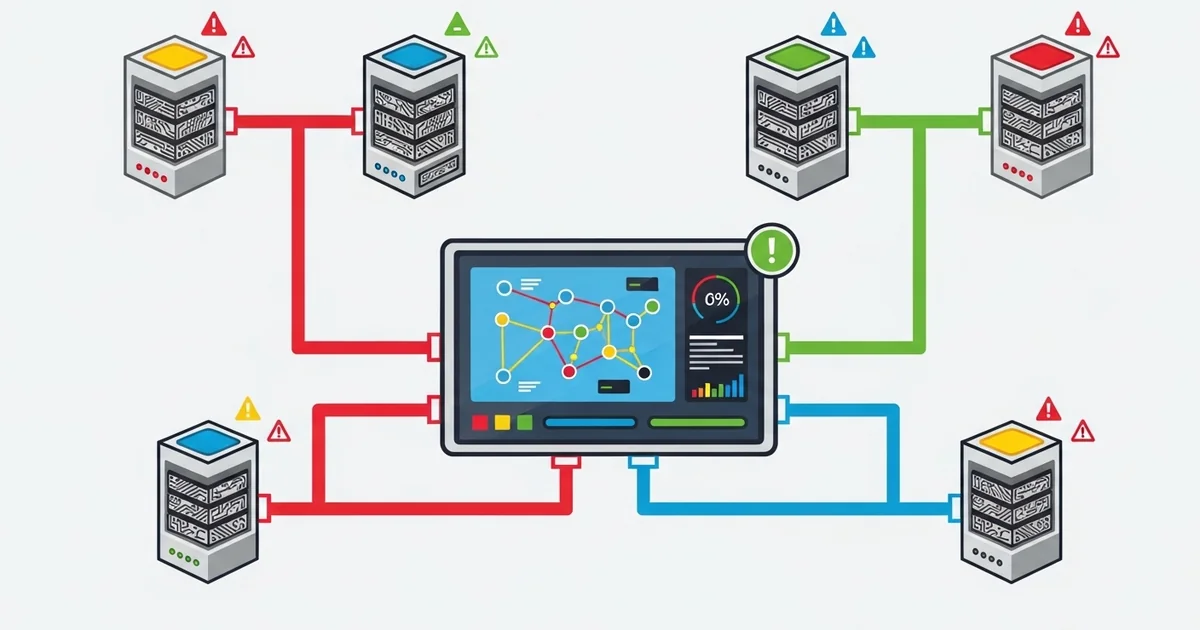
This solution deploys a single intelligent appliance at each site, accessible through a unified portal that reaches every location regardless of network status. You can diagnose failures, execute recovery commands, and monitor system health even when in-band tools are completely unavailable, dramatically reducing downtime across your retail branches, edge data centres, and remote equipment racks.
A switch fails at a branch site. There is no IT staff on site. The nearest engineer is hours away by road. The monitoring platform that should tell you what happened runs on the same link that just went down.
This is the routine reality of distributed infrastructure: retail branches, edge data centres, remote racks. In-band tools reach a device only while the network is healthy, which is the one moment you do not need them. When the link is down, the options narrow to a truck roll or a long outage.
Out-of-band management is a dedicated path to a site’s infrastructure that does not depend on the production network. A serial console connects to each device’s console port via RS-232, below the operating system and below IP, and a cellular link carries that path independently of the site’s WAN. When the production link is down, the OOB path still reaches every console port, so a remote engineer can diagnose and recover without travelling to the site.
One appliance per site, one portal for all of them
ZPE Systems’ Nodegrid platform was built for this pattern. A single appliance per site combines serial console access, a router, and a dual-SIM cellular OOB path. ZPE Cloud manages every site from one portal over that path. The result is that a small team can operate many sites it never visits.
Living Spaces: 50 retail sites, three network staff
Living Spaces, a US furniture retailer, grew from California into Texas, Arizona, Colorado, Oklahoma and other states. Its out-of-band infrastructure was central to opening new locations, but each site needed several dedicated cellular and OOB devices and the estate carried around 300,000 US dollars a year in SIM contracts. Consolidating onto Nodegrid removed those separate boxes, centralised management to cut entry points, and let the three-person team automate deployments rather than staff each one.
Vapor IO: edge data centres, eight hours down to one
Vapor IO runs micro edge data centres across 36 US markets and Barcelona, with a goal of lights-out sites and minimal staff. Each location once needed at least five separate management devices and at least 5RU of rack space that could otherwise be leased, plus roughly eight hours of on-site setup. The company moved to the modular Nodegrid Net SR: an LTE module for remote access and an SFP module to the nationwide fibre backbone, with deployment automated down to about one hour.
- [1]Serial console access via RS-232, below the OS and below IP, working when Ethernet is down
- [2]Dual-SIM 4G/LTE out-of-band path independent of the site’s production WAN
- [3]Zero-touch provisioning: ship, power on, pull config, no on-site technician
- [4]ZPE Cloud: every site in one portal, reachable over the OOB path
- [5]Console, router, and cellular gateway consolidated into one appliance
Why in-band tools are not enough
SSH and web dashboards reach a device only through the production network. When that network is down, congested, or mid-reconfiguration, those tools go dark at the exact moment they are needed. The out-of-band path avoids the dependency: it runs over a separate cellular link, so the state of the production WAN does not decide whether you can reach the site.
For distributed and branch infrastructure, this is becoming standard practice rather than a special case. The sites are too many and too scattered to staff, and a truck roll for every fault does not scale. One consolidated appliance per site, managed centrally over OOB, is what makes lights-out remote operation work.
Frequently asked questions
Out-of-band management is a dedicated path to a site’s infrastructure that does not depend on the production network. A serial console connects to each device’s console port via RS-232, below the operating system and below IP, and a cellular link carries that path independently of the site’s WAN. When the production link at a remote site is down, the OOB path still reaches every console port, so a remote engineer can diagnose and recover without travelling to the site.
By consolidating per-site management onto a single appliance and managing all sites from one cloud portal over the OOB path. ZPE Nodegrid combines serial console, router, and dual-SIM cellular gateway in one device, and ZPE Cloud presents every site in a single console. Living Spaces, a US furniture retailer, runs 50 sites with a three-person network team using this model, after consolidating away from several dedicated cellular and OOB devices per location.
Zero-touch provisioning lets a new appliance ship to a site, power on, reach the cloud over its cellular path, and pull its own configuration automatically, with no skilled technician required on site. At the edge this collapses deployment time. Vapor IO, which runs micro edge data centres across 36 US markets and Barcelona, cut per-site setup from around eight hours to roughly one after moving to the Nodegrid Net SR with automated deployment.
In-band tools such as SSH and web dashboards reach a device only through the production network. If that network is down, congested, or being reconfigured, the management tools become unreachable at the same moment they are needed. Out-of-band management avoids this by running the access path over a separate cellular link that is not affected by the state of the production WAN.
A consolidated platform needs one appliance. Many remote sites historically carried a separate cellular modem, OOB router, OOB switch, and serial console. Vapor IO’s earlier setup used at least five separate management devices and at least 5RU of rack space per site. A single Nodegrid appliance replaces that stack, which reduces points of failure, frees saleable rack space, and lowers SIM and maintenance costs.
ZPE’s branch and edge router family includes the Nodegrid Mini SR, Bold SR, Gate SR, Link SR, and Hive SR for smaller distributed sites, and the modular Nodegrid Net Services Router (Net SR) for sites that need integrated routing, LTE, and SFP fibre uplink. Vapor IO deployed the modular Net SR for its edge data centres. The right model depends on port count, throughput, and whether the site needs a full services router or a compact gateway.
Enova Technologies is a ZPE Systems partner in Singapore. Contact us to discuss out-of-band management for your branch, edge, or remote sites.
Ask us about Nodegrid for remote sites
Published by
eNOVA Technologies is Singapore's specialist distributor for data centre IT management solutions, representing Adder, Guntermann & Drunck, Raritan, Sunbird, ZPE Systems, and VuWall across Singapore and Southeast Asia. Our technical content is produced with AI assistance and reviewed by our in-house team before publication.
This article was produced with AI assistance and reviewed by the eNOVA Technologies team. All technical claims are verified against manufacturer documentation.