




Cooling in the tropics: what differential pressure and airflow sensing change

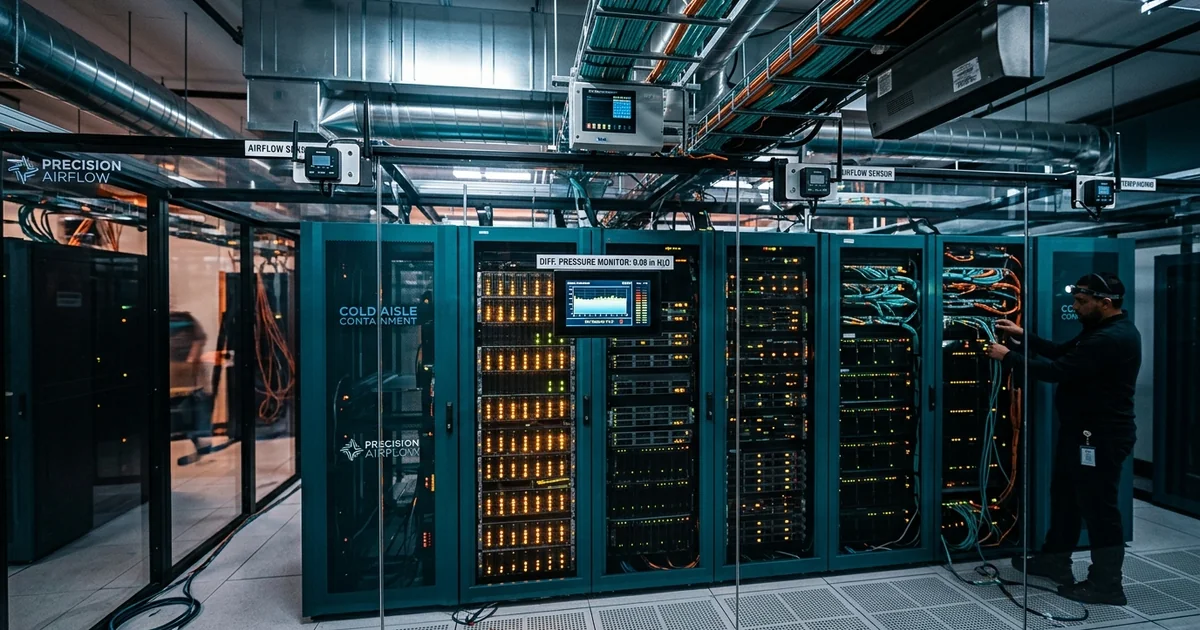
Tropical Data Centre Cooling: Sensing Solutions
Tropical data centres face unique cooling challenges that temperate facilities never encounter. Operating in constant heat and humidity, facilities like those in Singapore must run mechanical cooling year-round without access to cool outdoor air, making efficient thermal management critical to operational success and energy costs.
Raritan’s DX2-T1DP1 and DX2-AF1 sensors provide direct measurement of differential pressure and airflow within data centre aisles, eliminating guesswork about containment performance. By capturing real-time thermal data at the point of measurement rather than relying on inference from rack-inlet readings, operators gain precise visibility into cooling distribution and can optimize efficiency in high-heat environments.
Cooling in the tropics: what differential pressure and airflow sensing change
A data centre in Singapore runs mechanical cooling every day of the year, with no cool, dry outdoor air to lean on the way a temperate-climate facility can. Raritan’s DX2-T1DP1 and DX2-AF1 sensors measure the aisle directly, differential pressure and airflow, rather than inferring containment performance from a rack-inlet thermometer.
Most thermal monitoring in a data centre happens at one point: a temperature sensor at the rack inlet, checked against a threshold. That confirms the equipment inside the rack is operating within range. It says nothing about whether the containment barrier next to it is actually sealing, or quietly leaking cold air into the hot aisle while the rack itself reads fine.
Containment has historically been treated as passive infrastructure: install it, assume it works, move on. As rack densities climb and efficiency budgets tighten, that assumption is getting more expensive to leave unchecked.
What aisle-level sensing means
Aisle-level sensing measures the containment system itself rather than the equipment it protects. A differential pressure sensor compares air pressure on the cold side of a barrier against the hot side, revealing leakage or recirculation. An airflow sensor measures air velocity at a specific point, such as a perforated tile, confirming whether conditioned air is reaching its intended destination rather than bypassing it.
Neither measurement replaces rack-level temperature monitoring. Both add a layer of visibility that rack-level monitoring cannot provide on its own.
Two sensors, two questions
The DX2-T1DP1 combines temperature and differential air pressure in one sensor, reading from -250 Pa to +250 Pa at an accuracy of ±1.5% of full scale. Mounted across a containment barrier, above a raised floor, or between hot and cold aisles, it shows the pressure difference that either keeps cold air where it belongs or lets it leak past the barrier and recirculate.
The DX2-AF1 reads airflow directly, from 0 to 4 m/s at ±5% of full scale. Positioned at a perforated tile or a rack inlet, it answers a question pressure alone cannot: is conditioned air actually arriving at the point it was sent to cool, or is it bypassing the equipment and returning to the CRAC or CRAH unit unused.
Raritan frames the shift plainly. Containment has been measured indirectly for years, through the equipment it protects rather than the barrier itself. Differential pressure and airflow sensing measure the barrier directly, and the resulting data can feed straight into a DCIM or building management dashboard that operations teams already use, rather than creating a separate monitoring silo.
One sensor port, not one cable per measurement
Both sensors are DX2 SmartSensors, part of the same product family as Raritan’s temperature, humidity, dust and water-leak sensors. They share a physical interface: dual RJ45 connectors that allow cascading, so a single bus or string can carry up to 32 sensor functions across as many as 12 sensor packages into one sensor port on a Xerus-enabled PX rack PDU, inline meter, rack transfer switch or PXO compact PDU. Standard Cat5/6 cable runs up to 30 m per segment.
For a facility that already runs Raritan PX4 or PRO4X PDUs, the practical effect is that adding aisle-level sensing is a cabling exercise rather than an infrastructure project. No new sensor controller, no separate monitoring platform, no rewiring of the rack power path. The sensor chain plugs into a port the PDU already has.
| DX2-T1DP1 measurement | Temperature and differential air pressure |
| DX2-T1DP1 pressure range | -250 Pa to +250 Pa |
| DX2-T1DP1 accuracy | ±1.5% FS at 20°C, 50% RH |
| DX2-AF1 measurement | Airflow velocity |
| DX2-AF1 range | 0 to 4 m/s |
| DX2-AF1 accuracy | ±5% FS |
| Connector | Dual RJ45, standard Cat5/6 cable |
| Cable run | Up to 30 m per sensor |
| Cascade capacity | Up to 32 sensor functions, 12 sensor packages, on one bus/string |
| Host device | Any Xerus-enabled PX rack PDU, inline meter, rack transfer switch or PXO compact PDU |
Why the return is larger in a tropical climate
A facility in a temperate climate can lean on outside air for part of the year, running economisers or free cooling when ambient conditions allow it. During those months, a containment leak costs less, since mechanical cooling is doing less of the work anyway.
Singapore’s climate does not offer that window. Outdoor air is warm and humid year round, so data centres here run mechanical cooling continuously rather than seasonally. Every leak past a containment barrier, every stretch of bypass airflow, every perforated tile pushing conditioned air somewhere no equipment needs it, works against active mechanical cooling for the full year rather than for part of it. Measuring where that is happening, instead of assuming the containment plan on paper still matches the room as built, carries a larger and more consistent payoff here than in a market with a free-cooling season to fall back on.
What this doesn’t replace. Pressure and airflow sensing show where an existing system is underperforming. They will not fix a facility that is fundamentally undersized, and they are not a substitute for a proper CFD study when designing a new hall from scratch. Treat them as the visibility layer for decisions on the room you already have.
Frequently asked questions
What is differential pressure sensing in a data centre?
Differential pressure sensing compares air pressure on one side of a containment barrier against the other, such as inside a cold aisle versus outside it, or above versus below a raised floor. A pressure difference in the expected direction indicates the barrier is holding. A pressure difference that collapses, or reverses, indicates leakage or recirculation between the two zones. Raritan’s DX2-T1DP1 reads this from -250 Pa to +250 Pa at ±1.5% of full scale, alongside temperature.
How is airflow sensing different from rack-inlet temperature monitoring?
A rack-inlet temperature sensor confirms the air actually reaching the equipment is within an acceptable range. It says nothing about whether conditioned air is reaching the intended location in the first place, or bypassing the equipment and returning unused. Raritan’s DX2-AF1 measures air velocity directly at a point such as a perforated tile, from 0 to 4 m/s at ±5% of full scale, closing that gap.
Can these sensors be added to an existing PX4 deployment?
Yes, provided the PDU is Xerus-enabled. DX2 SmartSensors connect through the sensor port already present on Raritan PX rack PDUs, inline meters, rack transfer switches and PXO compact PDUs, using standard Cat5/6 cabling with dual RJ45 connectors. No separate sensor controller or monitoring platform is required.
How many sensors can run on one sensor port?
Different types of DX2 SmartSensors can cascade on a single bus/string structure into one Xerus sensor port, supporting up to 32 sensor functions across as many as 12 sensor packages. Standard cable runs extend up to 30 m per sensor, using dual RJ45 connectors for daisy-chaining rather than a dedicated cable to each measurement point.
Does this replace CFD modelling or a broader cooling upgrade?
No. Differential pressure and airflow sensing give continuous, real-world visibility into how an existing containment system is performing. They do not replace computational fluid dynamics modelling for a new facility design, and they will not correct a facility that is fundamentally undersized for its load. They are best used to find and fix inefficiencies in a room that already exists.
Why does this matter more in a tropical climate like Singapore’s?
Data centres in temperate climates can use outside air for part of the year, reducing the cost of a containment leak during those months. Singapore’s year-round heat and humidity mean mechanical cooling runs continuously with no free-cooling season, so every leak or bypass works against active cooling for the whole year rather than part of it. Measuring containment performance directly delivers a more consistent return in a climate without that seasonal reprieve.
Adding sensing to a PX4 deployment
Enova Technologies is an authorised Raritan partner in Singapore. Tell us how many aisles you want visibility on and which PX4 or PRO4X PDUs are already in the rack, and we will size the DX2 sensor chain and confirm compatibility.
Ask about DX2 sensorsSources: Raritan, Beyond Containment: How Advanced Sensing Is Changing Data Center Cooling, raritan.com/blog, 1 June 2026. Specifications from the Raritan environmental sensors product page and the Raritan SmartSensor datasheet.

Published by
eNOVA Technologies is Singapore's specialist distributor for data centre IT management solutions, representing Adder, Guntermann & Drunck, Raritan, Sunbird, ZPE Systems, and VuWall across Singapore and Southeast Asia. Our technical content is produced with AI assistance and reviewed by our in-house team before publication.
This article was produced with AI assistance and reviewed by the eNOVA Technologies team. All technical claims are verified against manufacturer documentation.