



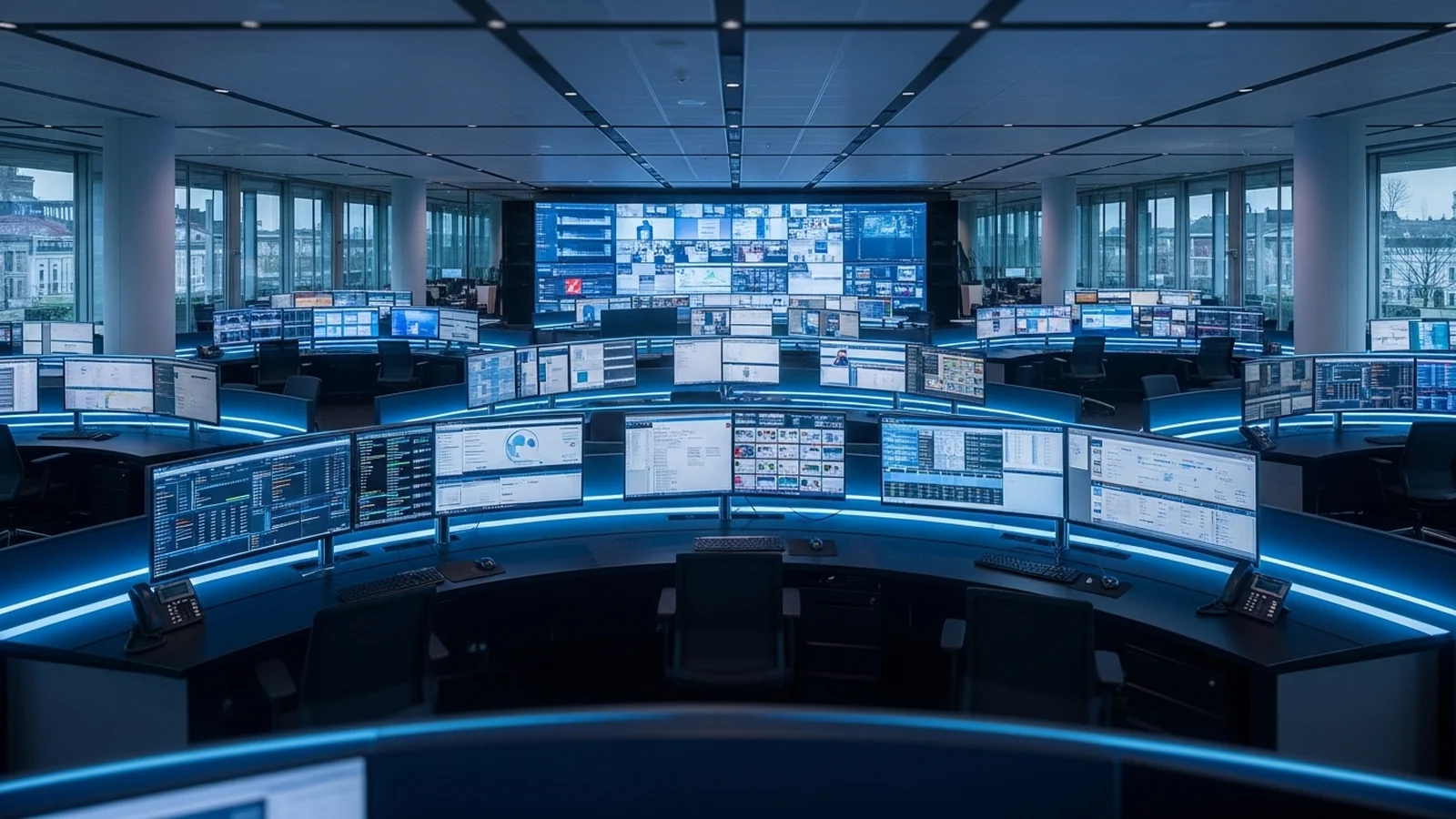
Industrial KVM in practice: a Mexican brewery and a German municipal utility

Industrial KVM Systems in Real-World Operations
Control rooms across critical industries face a common challenge: managing multiple computers and workstations in confined spaces while maintaining system reliability and security. Industrial KVM systems solve this by allowing operators to access and control distant computers from centralized locations, eliminating the need for cluttered equipment racks in control rooms.
Industrial KVM matrix solutions enable seamless switching between multiple computers and devices with minimal latency, essential for time-sensitive operations in utilities and manufacturing. By consolidating access through KVM technology, organizations reduce physical space requirements, improve equipment longevity, and enhance operational efficiency—as demonstrated by implementations across diverse sectors from beverage production to municipal power management.
Industrial KVM in practice: a Mexican brewery and a German municipal utility
G&D has published two case studies from industries that rarely appear together. Both projects start with the same decision: take the computers out of the control room and reach them over a KVM matrix instead.
Industrial control rooms accumulate machines. A process PC here, a telecontrol workstation there, an engineering box that only one person knows how to reboot. They sit under desks because that is where they were needed on the day they arrived. The result is a room that runs hot, sounds loud, and gives each seat access only to the computers physically wired to it.
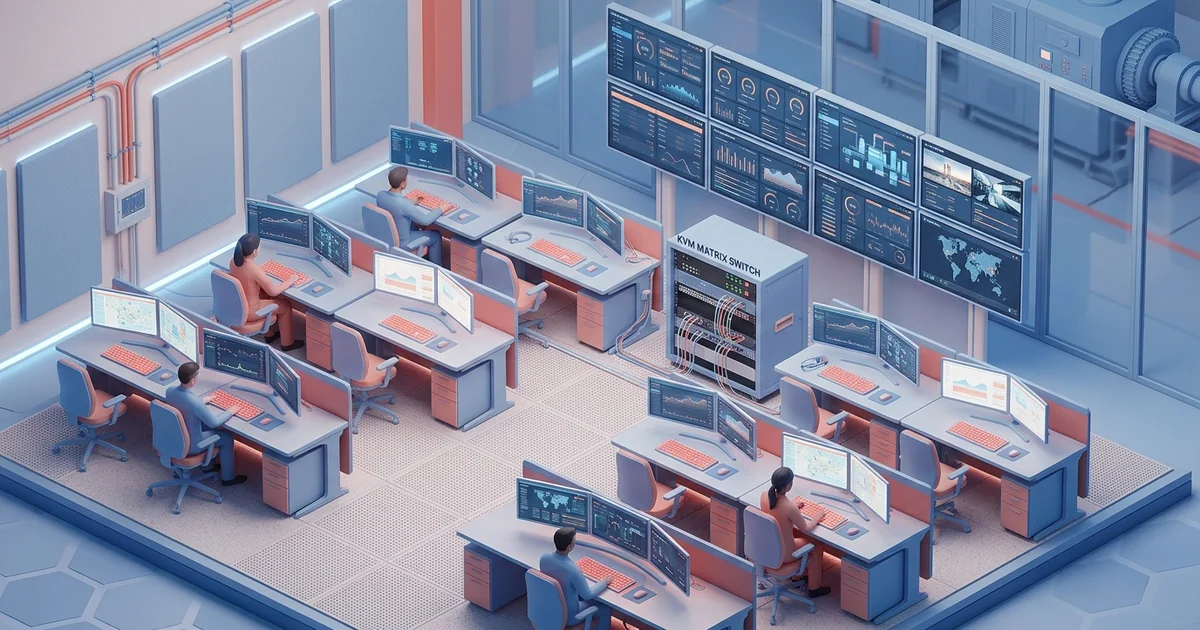
A KVM matrix inverts that. The computers move into a protected room. The desk keeps a monitor, a keyboard and a mouse, connected back over CAT or fibre. Any operator position can call up any machine, and the distance stops being something the operator has to think about.
Two recent G&D projects show the same architecture doing different jobs. One is a brewery in Mexico scaling up production. The other is a municipal utility in Baden-Württemberg rebuilding its network control centre.
What an industrial KVM matrix does
A KVM matrix is a switch that connects many computers to many operator workstations at the same time. Each computer gets a CPU module that captures its video, keyboard and mouse signals. Each desk gets a console module. The matrix in the middle routes any computer to any desk, over CAT or fibre cabling, in real time.
In an industrial setting the point is physical separation. Process and telecontrol computers live in a clean, cooled, access-controlled room, while the operators work in the control room with only peripherals in front of them. This is switching at the signal level, not remote desktop software, so it does not depend on the production network and adds no perceptible lag.
One architecture, two industries
The brewery: growing without stopping
One of Mexico’s largest breweries set out to lift annual capacity from 3.5 to 5 million hectolitres. Growth on that scale exposed what the existing setup could not carry. Separate control systems, computers distributed around the plant, and control rooms loud enough to wear out a shift. The brief called for central servers that could be integrated securely, control rooms that connected to each other, and operation that held up around the clock.
G&D worked with a local integrator to build the room around the ControlCenter-Compact matrix. Four decisions shaped the result.
Two matrices rather than one. A redundant pair means a failed unit does not take the control room with it, which is the difference between a maintenance ticket and a production stoppage.
Dual-head support. Two video signals travel down a single connection, cutting both the cabling run and the number of ports the system has to buy.
Mixed transmission media. CAT6 handles the short runs, multimode fibre crosses the site, and singlemode covers the longest distances. The server room ended up more than 100 m from the operators, which is ordinary for a matrix system and impossible with a computer under a desk.
Relocation of the computers themselves. That is the change the operators notice. The heat, the fan noise and the cable clutter left the room with the machines, and the desks got their space back.
The utility: one control room, every supply
Stadtwerke Mühlacker is a municipal energy and supply company in Baden-Württemberg. It supplies 36,559 households and 845 industrial sites with electricity, gas, water, heat and internet, and employs around 125 people. Its focus is decentralised and renewable generation, which is exactly the kind of supply mix that makes a control centre harder to run: more sources, more telemetry, more things to keep an eye on at once.
When the network control centre was rebuilt, the cabling infrastructure was reworked and the computing moved into a protected area. The relocated machines include several office PCs, the control centre telecontrol PC and the ripple control unit. All of them connect through KVM CPU modules to a compact matrix, and every configured workstation can now operate any of them.
Two functions do the daily work in that room. Push-Get lets an operator send a screen to a colleague’s position or pull one across to their own, which is how a handover or a second opinion actually happens. Autoscan cycles the electricity, water and gas telecontrol systems onto the central video wall at a set interval, giving a rolling view of every supply point without anyone having to remember to check.
What the two projects have in common
Different problems
- Brewery: production capacity and 24/7 uptime
- Utility: a rebuilt control centre for a decentralised supply mix
- Brewery: a plant floor with distributed control systems
- Utility: one room watching four supply types at once
Same answer
- Computers relocated to a protected room
- KVM matrix bringing them back to every desk
- Redundancy specified at design stage, not retrofitted
- Ergonomics listed as a headline outcome by both
The pattern worth noticing is that neither project treated KVM as a convenience. In both, it was the mechanism that let a physical constraint be designed out. The brewery could not centralise its servers without a way to reach them from the floor. The utility could not consolidate four supply systems into one room without a way to put every machine in front of every operator.
ControlCenter-Compact at a glance
| System type | Compact KVM matrix switch, central module |
| Port count, CAT | 8 to 176 dynamic ports |
| Port count, fibre | 16 to 48 dynamic ports, multimode or singlemode |
| Port count, mixed | 32 to 112 dynamic ports across CAT and fibre |
| Rack height | 1 to 3 RU depending on model |
| Transmission media | CAT5e, CAT6, CAT7, multimode fibre, singlemode fibre |
| Power | Internal power supply, redundant power supply available |
| Management | Network connection including monitoring |
| Redundancy | Second matrix can be deployed as a redundant pair |
Reading this from Singapore
The industries translate directly. Process plants on Jurong Island, water and power operations, wafer fabs, food and beverage production and building management centres all run control rooms with the same three complaints: the room is hot, the room is loud, and the machines are in the wrong place.
The heat argument carries more weight here than it does in Baden-Württemberg. Every watt a computer dissipates in an air-conditioned control room has to be removed again by the air conditioning, year round. Moving that load into a room already built to be cooled takes it off the operators and off the control room’s cooling budget.
One thing KVM does not do is worth saying plainly. It moves the computers. It does not replace a SCADA or telecontrol system, and it does not segregate networks by itself. G&D sets out the prerequisites in the Mühlacker write-up: an optimised cabling infrastructure, and where it applies, separation of the different networks. Both belong in the design before the matrix is ordered.
Frequently asked questions
What is an industrial KVM matrix?
A KVM matrix is a switch that connects many computers to many operator workstations simultaneously. Each computer gets a CPU module and each desk gets a console module, with the matrix routing any computer to any desk over CAT or fibre cabling. In industrial use it allows process and telecontrol computers to be housed in a protected room while operators work with only a monitor, keyboard and mouse in front of them.
Why move computers out of the control room?
Three reasons appear in both G&D case studies. The room becomes quieter and cooler once the machines and their fans are gone, which matters across a long shift. The computers sit in a protected, access-controlled space rather than under a desk on a plant floor. And every operator position gains access to every machine, instead of only the ones physically cabled to that desk.
Does a KVM system replace SCADA or a telecontrol system?
No. KVM changes where the computer physically sits and who can reach it. The SCADA, telecontrol and process control software continues to run on the same machines as before. At Stadtwerke Mühlacker the telecontrol PC and the ripple control unit were relocated and reached through KVM modules, not replaced.
How far can the computers be from the operators?
At the Mexican brewery the server room sits more than 100 m from the control room. CAT cabling covers typical in-building distances, and fibre extends the reach further, with multimode for cross-site runs and singlemode for the longest. The transmission medium is chosen per connection, so one matrix can mix CAT6, multimode and singlemode across the same installation.
What does redundancy mean in a KVM matrix, and do we need it?
It means a second matrix deployed alongside the first so that no single unit can take the control room offline. The brewery uses two redundant ControlCenter-Compact systems to protect 24/7 production; Stadtwerke Mühlacker uses one redundant matrix system. Whether you need it follows from what stops when the control room stops, so decide it before sizing ports rather than after.
What has to be in place before installing a KVM matrix?
G&D names two prerequisites in the Mühlacker case study: an optimised cabling infrastructure between the protected room and the operator positions, and where it applies, separation of the different networks. Beyond that the requirements are modest, which is why the Mühlacker project describes implementation as simple. Both prerequisites are cheaper to resolve during a control room refit than afterwards.
Sizing an industrial control room
Enova Technologies is an authorised G&D partner in Singapore. Send us the number of machines, the number of operator positions and the distance from your server room to the control room, and we will come back with a port count, a cabling approach and a topology.
Ask about industrial KVMSources: G&D case study, Brewing Beyond Borders: How a Mexican Brewery Future-Proofs Its Production with KVM Systems from G&D. G&D case study, Smart City: Stadtwerke Mühlacker. Port counts and transmission media from the G&D ControlCenter-Compact product page.

Published by
eNOVA Technologies is Singapore's specialist distributor for data centre IT management solutions, representing Adder, Guntermann & Drunck, Raritan, Sunbird, ZPE Systems, and VuWall across Singapore and Southeast Asia. Our technical content is produced with AI assistance and reviewed by our in-house team before publication.
This article was produced with AI assistance and reviewed by the eNOVA Technologies team. All technical claims are verified against manufacturer documentation.