
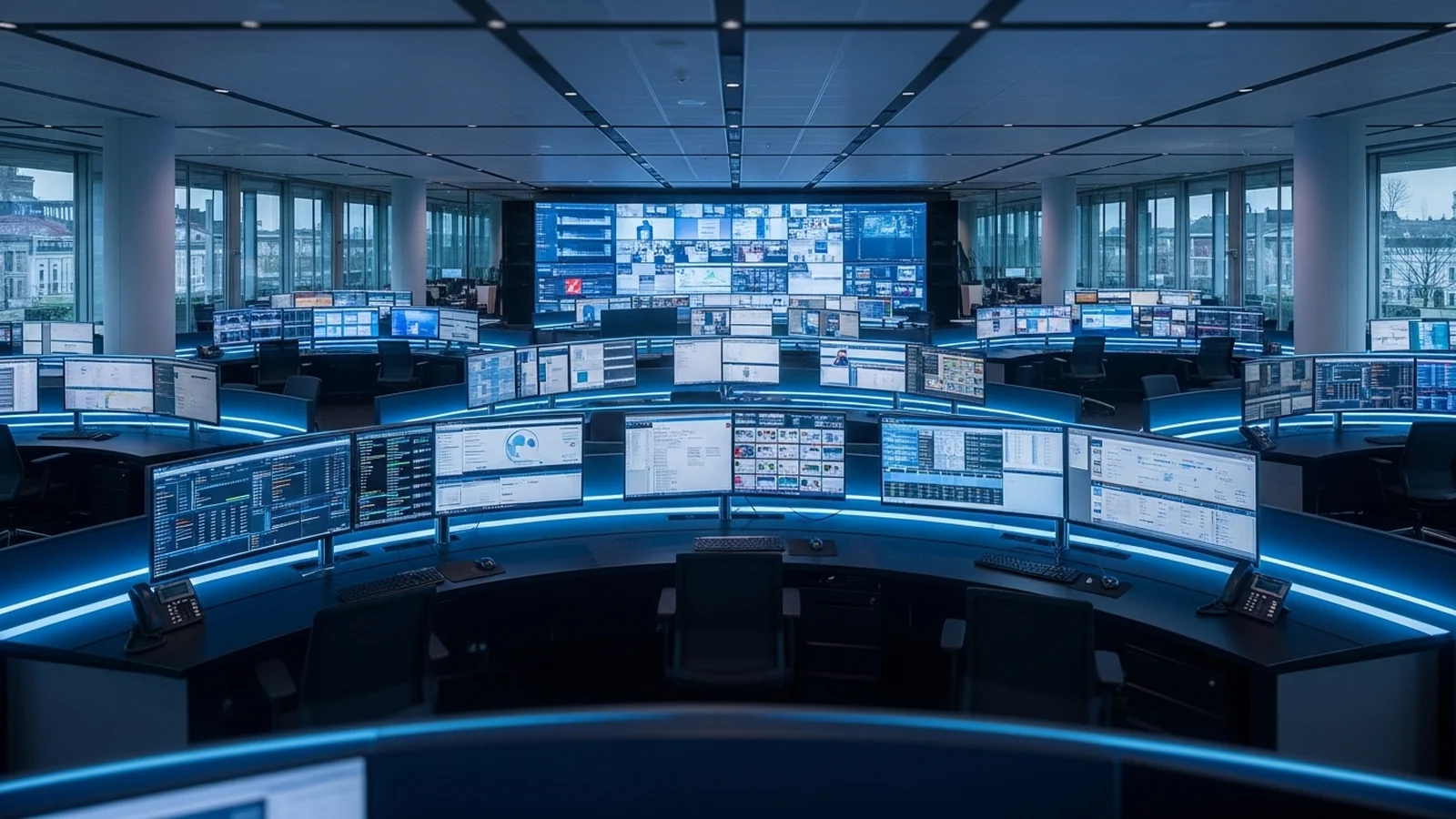
Live on air, and the switch just failed. What happens next?

KVM Switch Redundancy: Your Broadcast Safety Net
Broadcast control rooms invest heavily in redundancy—backup servers, failover encoders, secondary transmission paths—yet many overlook a critical vulnerability: their KVM management layer. When the switch providing operator access to production systems fails during a live broadcast, the consequences can be catastrophic, leaving your team unable to manage critical infrastructure when it matters most.
The Adder AIM 6 delivers enterprise-grade KVM switch redundancy designed specifically for broadcast environments, ensuring operators maintain continuous access to all production systems even when primary hardware fails. With automatic failover capabilities and dual-path architecture, this solution eliminates single points of failure in your management infrastructure, keeping your on-air operations running without interruption.
Enova Technologies | Adder AIM 6
Live on air, and the switch just failed. What happens next?
Every broadcast control room has contingency plans. Backup playout server. Redundant encoder. Secondary transmission path. The rehearsals cover source failure.
The scenario most control rooms skip is KVM management layer failure. The server that provides operators access to every production system sits in a single point between the desk and the rack. When it fails during a live show, every session through it drops at the same time. Playout. Graphics. Audio. All gone simultaneously.
With a standard IP KVM management server, recovery means manually identifying the fault, restoring the manager, and re-establishing each session individually. In a live broadcast environment, that process typically takes 5 to 15 minutes. That is not a recoverable window during transmission.
What is KVM Hot Standby?
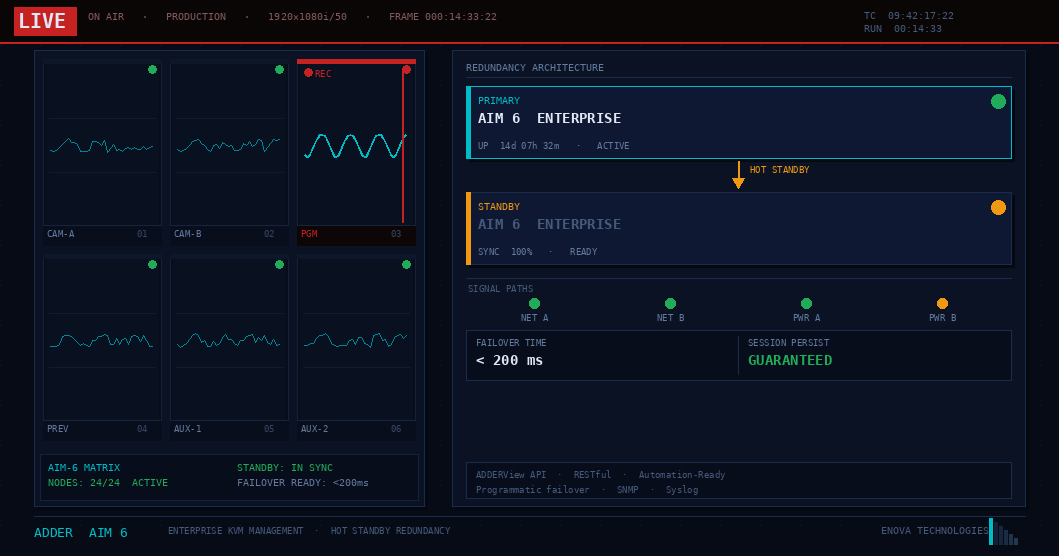
KVM hot standby is a redundancy architecture where a secondary KVM management server continuously mirrors the primary server’s configuration and session state. If the primary fails, the secondary activates automatically, preserving all existing operator sessions without any manual intervention. In the Adder AIM 6 implementation, this failover completes in under one second. The operator retains access to all connected production servers through the transition.
What breaks when the management server goes offline
Standard KVM Manager
A single management server is a single point of failure. When it goes offline, every operator session drops regardless of which physical switch handles the underlying connection.
Adder AIM 6: Hot Standby
Secondary AIM 6 mirrors the primary continuously. On primary failure, the secondary activates automatically and all sessions are maintained. The operator does not need to re-authenticate or reconnect.
The failover timeline makes the distinction concrete. With a standard setup, access to production servers is lost the moment the manager fails and stays down until manual recovery is complete. With AIM 6 hot standby, there is a brief transition window of under one second before the secondary is fully active. In a live production environment, this is the difference between an event that goes unnoticed and one that requires an on-air apology.
Programmatic control for broadcast automation integration
The AIM 6 exposes the ADDERView API, a RESTful interface that allows external systems to control KVM switching operations programmatically. Broadcast automation controllers, production management systems, or custom scripts can use the API to initiate source changes, trigger failover sequences, and confirm connection status without requiring an operator to manually switch sources.
In practice, this means the failover sequence does not depend on human reaction time. The broadcast controller detects the failure condition and calls the API. The AIM 6 re-routes the connection. The operator is notified that a switch has occurred rather than scrambling to initiate one. The difference matters most during live events where the reaction window is measured in seconds.
KVM management layer capabilities for live production environments
| Capability | Standard KVM | Adder AIM 6 |
| Hot standby management server | ✗ | ✓ |
| Sub-second failover on manager failure | ✗ | ✓ |
| Existing sessions preserved through failover | ✗ | ✓ |
| RESTful API for programmatic switching (ADDERView) | ✗ | ✓ |
| Automated failover via broadcast automation integration | ✗ | ✓ |
| Centralised multi-site IP KVM management | ✓ | ✓ |
The backup playout server gets tested every quarter. The KVM management server that connects to it is almost never tested for failure. It runs continuously, assumed reliable, with no hot spare. It is the one element in the signal chain the contingency plan forgot to cover.
Frequently Asked Questions
What is Adder AIM 6?
Adder AIM 6 (ADDERLink Infinity Manager 6) is a centralised IP KVM management platform. It provides a single interface for administering ADDERLink Infinity IP KVM endpoints across one or multiple sites. The AIM 6 supports hot standby redundancy: a secondary server mirrors the primary continuously and activates automatically if the primary fails, preserving all existing operator sessions.
What is KVM hot standby and how does it work in a live broadcast environment?
KVM hot standby is a redundancy architecture where a secondary KVM management server continuously mirrors the primary. If the primary fails, the secondary activates automatically. In the Adder AIM 6 implementation, failover completes in under one second and existing operator sessions are preserved. In a live broadcast environment, this means operators retain access to playout, graphics, and audio systems without manual intervention when the primary manager fails.
What is the ADDERView API and how does it enable broadcast automation?
The ADDERView API is a RESTful interface provided by Adder AIM 6 that allows external systems to control KVM switching operations programmatically. Broadcast automation systems, production controllers, or custom scripts can use the API to trigger source changes, initiate failover sequences, and confirm connection status. This enables automated KVM workflows in live production environments where manual switching speed is insufficient.
What happens to active KVM sessions when the management server fails?
With a standard KVM management server, all active sessions are lost when the manager fails. Operators lose access to every system behind the KVM simultaneously. Manual recovery involves identifying the fault, restoring the manager, and re-establishing each session. With Adder AIM 6 hot standby, the secondary activates in under one second and existing sessions are preserved. No manual intervention is required.
How long does manual recovery from a KVM manager failure typically take?
Manual recovery from a KVM management server failure in a broadcast environment typically takes 5 to 15 minutes. The process includes identifying which component failed, locating backup credentials or recovery procedures, restarting or replacing the KVM manager, and re-establishing individual sessions to playout, graphics, and audio systems. In a live broadcast, this window can result in loss of on-air content.
Which broadcast environments benefit most from Adder AIM 6 hot standby?
AIM 6 hot standby is most valuable in live broadcast environments where access to production servers must be uninterrupted: live sports production, news broadcasting, event coverage, and 24-hour broadcast operations. Any environment where a KVM management failure would cause on-air disruption or require immediate manual intervention benefits from AIM 6 redundancy. The ADDERView API integration provides additional value in highly automated production workflows.
Enova is an authorised Adder partner in Singapore. We can walk through how AIM 6 hot standby and the ADDERView API are deployed in broadcast and live production environments.
Talk to us about broadcast KVM resilience
Published by
eNOVA Technologies is Singapore's specialist distributor for data centre IT management solutions, representing Adder, Guntermann & Drunck, Raritan, Sunbird, ZPE Systems, and VuWall across Singapore and Southeast Asia. Our technical content is produced with AI assistance and reviewed by our in-house team before publication.
This article was produced with AI assistance and reviewed by the eNOVA Technologies team. All technical claims are verified against manufacturer documentation.