



What Is an Intelligent PDU? Smart Power Management for Data Centres

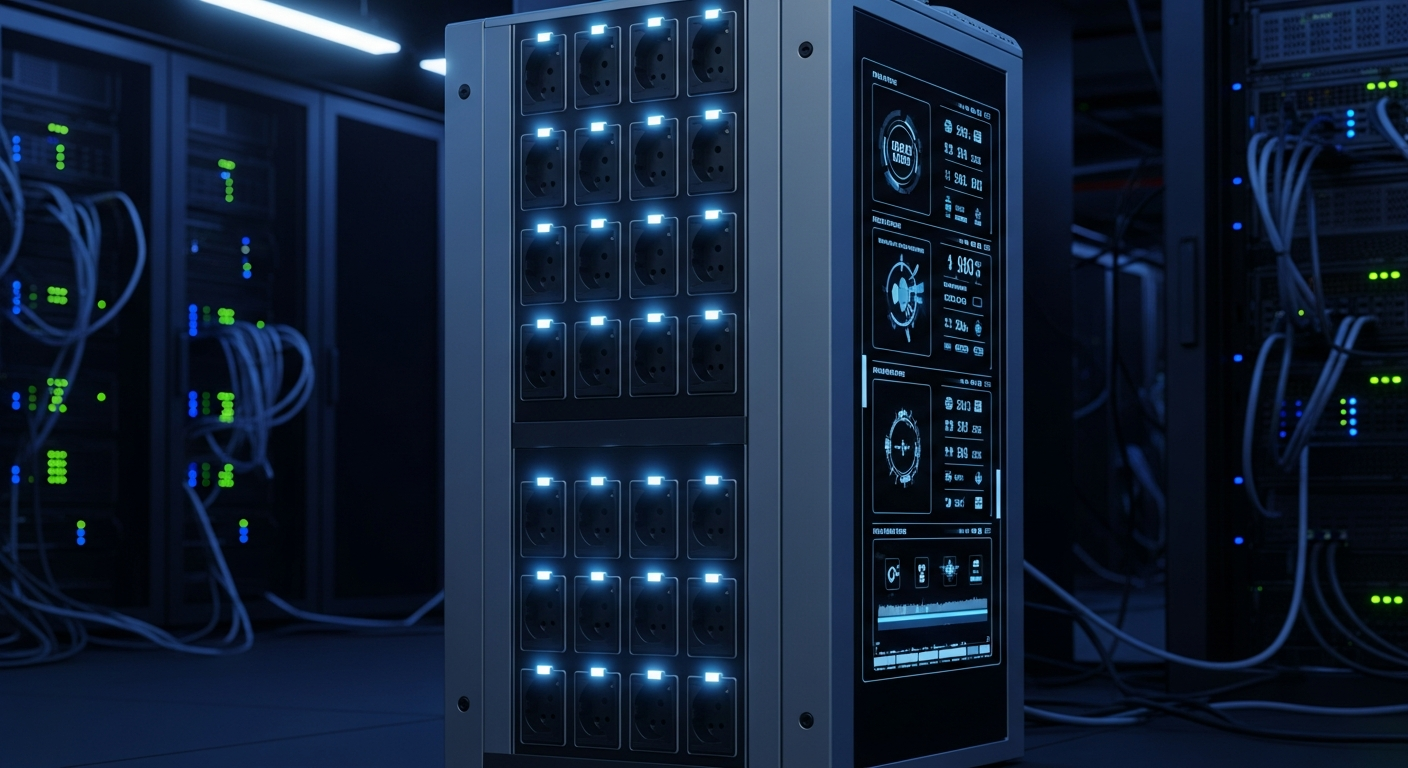
An intelligent PDU (iPDU) is a rack-mounted power distribution unit equipped with embedded intelligence to monitor, measure, and control power delivery at the rack, outlet, or phase level. Unlike a basic power strip, an iPDU communicates over a network, feeding real-time electrical data into management systems and enabling remote intervention before small power anomalies become costly downtime events.
Why Do Data Centres Need More Than a Basic PDU?
A standard PDU does one thing: distribute mains power to connected equipment. It carries no sensors, offers no visibility, and provides no means of remote control. In a modern data centre where rack densities regularly exceed 10 kW and power usage effectiveness (PUE) is under constant scrutiny, that level of ignorance is operationally untenable. Undetected phase imbalances, unplanned load growth, and unreachable hung servers all translate directly into energy waste, hardware risk, and unplanned engineer callouts.
Intelligent PDUs address each of those gaps by embedding measurement circuitry, environmental sensors, and a network interface into the PDU chassis itself — pushing actionable data to operators without requiring additional hardware at every rack.
What Are the Four Tiers of PDU Intelligence?
The industry broadly recognises four functional tiers. Each tier is a superset of the one below it, so understanding the progression helps facilities managers match procurement to operational requirements.
Tier 1 — Basic PDU: What Does It Actually Do?
A basic PDU provides passive power distribution only. It contains a main inlet, circuit breakers or fuses, and a set of outlets. There is no metering, no network port, and no remote capability. These units are appropriate solely for environments where power monitoring is handled entirely upstream at the UPS or breaker panel.
Tier 2 — Metered PDU: What Gets Measured?
A metered PDU adds input-level measurement, typically reporting total current draw (in amperes) via a local LCD display. Some models extend measurement to voltage and apparent power (VA). There is still no network connectivity and no outlet-level granularity, but the LCD reading gives on-site engineers a quick capacity check during maintenance visits.
Tier 3 — Monitored PDU: How Is Data Delivered Remotely?
A monitored iPDU integrates a network interface — most commonly a dual Ethernet port supporting 10/100/1000BASE-T — and an embedded web server, enabling SNMP, Modbus TCP, RESTful API, and IPMI communication. Sensors at this tier typically cover:
- Current per outlet and per phase (resolution to 0.1 A or better)
- Voltage per line, with thresholds configurable to ±5% of nominal
- Active power (watts) and apparent power (VA)
- Power factor per phase, critical for identifying capacitive or inductive load imbalances
- Energy consumption in kWh, enabling per-rack billing or chargeback
- Temperature and humidity via external sensor ports (typically RJ-12 or USB), placed at intake and exhaust positions
Alert thresholds can be configured for every measured parameter, and the unit will dispatch SNMP traps or email notifications autonomously when a threshold is breached — without requiring polling from a central management system.
Tier 4 — Switched and Managed PDU: What Can Be Controlled Remotely?
A switched iPDU adds individual outlet-level relay switching to the monitoring capability of Tier 3. Each outlet can be powered on, powered off, or power-cycled independently via network command, scheduled automation, or manual web-GUI action. This capability underpins several operationally significant use cases:
- Remote server reboot without dispatching an engineer to the data hall
- Sequential power-on sequencing to prevent inrush current spikes during a facility recovery
- Scheduled outlet cycling to restart network appliances during defined maintenance windows
- Load shedding in response to generator or UPS capacity constraints
Which Sensors Does an iPDU Typically Include?
Sensor coverage varies by model and tier, but a well-specified managed iPDU will expose the following measurement points simultaneously:
| Parameter | Measurement Point | Typical Accuracy |
|---|---|---|
| Current | Per outlet, per phase, per inlet | ±1% of full scale |
| Voltage | Per line-to-neutral, per line-to-line | ±1% of reading |
| Active power | Per outlet, per phase | ±1% of full scale |
| Power factor | Per phase | ±0.02 |
| Energy (kWh) | Per outlet, cumulative | ±1% of full scale |
| Temperature | External sensor, up to 8 per PDU | ±0.5 °C |
| Humidity | External sensor, combined T+H probe | ±3% RH |
External environmental sensors connect via a dedicated sensor bus, allowing a single iPDU to aggregate temperature and humidity readings from multiple points within a rack or cabinet — delivering a thermal map of the enclosure without additional infrastructure.
How Does Cascade and Daisy-Chain Connectivity Work?
High-density racks often require two or more PDUs per cabinet to serve all outlets. Daisy-chaining — sometimes referred to as cascading — allows multiple iPDU units to share a single network uplink. One primary unit connects to the network switch; secondary units link to the primary via a dedicated cascade port, each appearing as a distinct node with its own IP address or as a sub-device under the primary’s address. This architecture reduces switch port consumption and simplifies cable management in high-PDU-count deployments. Cascade chains of up to 16 units are supported on some platforms, allowing a single network drop to serve an entire row of racks.
How Do Intelligent PDUs Integrate with DCIM?
Data centre infrastructure management (DCIM) platforms ingest iPDU data via SNMP v1/v2c/v3, RESTful APIs, or proprietary agent-based connectors. Once integrated, DCIM can correlate power draw with cooling load, asset inventory, and capacity planning models. Practical outcomes include:
- Automated capacity alerts when a rack approaches its breaker rating (typically 80% of circuit capacity)
- Historical trending for peak demand analysis and right-sizing future deployments
- Granular chargeback reporting per outlet, per server, per tenant
- Unified alarming alongside network, thermal, and environmental events
iPDUs that support open standards — SNMP MIBs, ODATA, RESTful JSON — integrate with any major DCIM platform without vendor lock-in.
What Makes the Raritan PX3 and PX4 Series Notable?
Raritan’s PX3 series represents a mature, widely deployed managed iPDU platform offering outlet-level switching, phase-level metering to ±1% accuracy, and an eight-sensor-port environmental bus. The PX3 supports dual Ethernet with failover, SNMP v1/v2c/v3, Modbus TCP, and a RESTful API, making it compatible with virtually any DCIM platform in current use. Models are available in single-phase and three-phase configurations with IEC or NEMA outlet formats, covering standard 1U to high-density 0U vertical installations.
The Raritan PX4 series advances on the PX3 platform with higher-resolution metering, enhanced processor performance for faster polling cycles, and expanded cascade support. The PX4 also introduces improved TLS 1.3 security for all management interfaces and supports USB-connected cellular modems for out-of-band management in facilities without dedicated management LANs. Both the PX3 and PX4 series are available in Singapore through eNOVA Technologies, which provides local pre-sales configuration support, warranty handling, and integration assistance.
What Should You Consider When Specifying an iPDU?
Before selecting a PDU tier or model, engineers and facilities managers should evaluate the following parameters against site requirements:
- Input voltage and phase: single-phase 230 V, three-phase 400 V, or three-phase with neutral
- Inlet current rating: 16 A, 32 A, or higher, matched to the branch circuit
- Outlet count and type: IEC C13, IEC C19, or mixed, based on server PSU formats
Frequently Asked Questions
What is the difference between a smart PDU and an intelligent PDU?
A smart PDU typically offers basic monitoring and alerting capabilities, while an intelligent PDU (iPDU) provides advanced features like outlet-level control, predictive analytics, and API integration for automated power management. Intelligent PDUs enable remote intervention and deeper integration with data centre management platforms, whereas smart PDUs are often limited to read-only visibility. For facilities managing critical workloads, an iPDU’s control capabilities justify the higher investment.
Can an intelligent PDU help reduce my data centre power costs?
Yes—iPDUs reduce costs by identifying phase imbalances, detecting power waste, and enabling right-sizing of capacity before expensive infrastructure upgrades become necessary. Real-time outlet-level metering reveals which equipment consumes more power than expected, allowing operators to optimize workload placement and eliminate phantom loads. Many data centres report 5–15% energy savings within the first year of iPDU deployment.
How do I choose between Tier 2, Tier 3, and Tier 4 PDUs for my data centre?
Tier 1–2 PDUs suit small, stable environments with predictable loads and minimal control requirements. Tier 3 adds outlet-level metering and switching, ideal for mid-sized facilities managing multi-tenant or variable workloads. Tier 4 includes environmental sensors, predictive analytics, and full API automation—essential for hyperscale operations or facilities prioritizing PUE optimization and autonomous power management.
Do intelligent PDUs work with existing data centre management software?
Most modern iPDUs support industry-standard protocols (SNMP, REST APIs, and Modbus) and integrate with leading DCIM platforms like Nlyte, Schneider EcoStruxure, and Vertiv Liebert. Integration capabilities vary by vendor and tier level, so verify API documentation and compatibility matrices during procurement. Cloud-native iPDU solutions also offer direct integration with hyperscaler management consoles.
What is PUE and how does an intelligent PDU improve it?
Power Usage Effectiveness (PUE) is the ratio of total data centre power consumption to IT equipment power consumption—lower scores indicate better efficiency. Intelligent PDUs improve PUE by eliminating blind spots in power distribution, enabling load balancing across phases, and detecting cooling-related power waste through environmental telemetry. Data centres typically improve PUE by 0.1–0.3 points after implementing iPDU monitoring across all racks.
Are intelligent PDUs common in Singapore and Southeast Asian data centres?
Yes—Tier 3 and Tier 4 iPDUs are now standard in Tier III/IV-certified data centres across Singapore, Malaysia, and Australia, driven by competitive pressure and customer demands for transparency on power efficiency. Hyperscalers and financial services firms operating in APAC require iPDU deployment as a baseline operational requirement. Local power cost volatility and high cooling expenses make iPDU ROI particularly strong in the region.

Published by
eNOVA Technologies is Singapore's specialist distributor for data centre IT management solutions, representing Adder, Guntermann & Drunck, Raritan, Sunbird, ZPE Systems, and VuWall across Singapore and Southeast Asia. Our technical content is produced with AI assistance and reviewed by our in-house team before publication.
This article was produced with AI assistance and reviewed by the eNOVA Technologies team. All technical claims are verified against manufacturer documentation.