


Decoding FIPS 140-3: What the New Standard Means for Cybersecurity

Safeguarding sensitive data is a shared responsibility for countless organizations. Protecting data—whether it’s moving across networks or stored at rest—is essential not only to earn and maintain the trust of end users and customers but also to comply with regulatory requirements. One of the most dependable strategies for securing data within network infrastructures is the use of cryptographic solutions certified under FIPS 140-3. Developed by the National Institute of Standards and Technology (NIST), this certification sets a high benchmark for encryption practices, helping organizations achieve stringent security standards and regulatory compliance.
In this article, we’ll delve into what FIPS 140-3 certification entails, why it’s so crucial, and how it is applied within modern network infrastructures.
What is FIPS 140-3 Certification?
FIPS 140-3 certification is a rigorous, government-backed security standard that establishes guidelines for cryptographic modules designed to safeguard sensitive information. It sets forth specific requirements for protecting cryptographic functions within hardware, software, and firmware. The certification process meticulously evaluates cryptographic solutions for their security and reliability, ensuring they meet strict criteria in areas such as data encryption, access control, and physical security.
This standard is divided into four distinct levels, each offering progressively stronger protection to secure data across different environments:
- Level 1: Establishes basic encryption protocols.
- Level 2: Introduces tamper-evident measures along with role-based authentication.
- Level 3: Enhances security with advanced tamper-resistance and robust user authentication.
- Level 4: Provides the highest level of protection, incorporating physical safeguards to counteract tampering.
Achieving FIPS 140-3 certification confirms that an organization’s network infrastructure complies with stringent cryptographic security standards, which is essential for defending sensitive data against cyber threats and meeting regulatory mandates.
Why FIPS 140-3 Certification Matters
Ensuring Regulatory Compliance
FIPS 140-3 certification is frequently required by regulatory bodies, especially in sectors such as government/defense, healthcare, finance, energy, and education—where protecting sensitive data is not just best practice but a legal mandate. For instance, this certification supports compliance with standards like DFARS and NIST SP 800-171 for defense, HIPAA for healthcare, PCI-DSS for finance, NERC CIP for energy, and FERPA for education. Moreover, adhering to FIPS 140-3 helps organizations streamline audits and minimize the risk of fines or penalties resulting from security lapses.
Enhancing Customer Confidence
In today’s digital landscape, customers expect their information to be safeguarded with the utmost care. By utilizing FIPS 140-3-certified solutions, organizations signal a strong commitment to data protection using trusted, government-endorsed standards. This certification serves as a compelling trust indicator, reassuring customers that their sensitive data is managed with the highest levels of security available.
Defending Against Evolving Cyber Threats
Relying on outdated or uncertified cryptographic solutions increases vulnerability to data breaches. FIPS 140-3-certified modules undergo rigorous testing to ensure they can withstand sophisticated cyberattacks and tampering. This robust level of security helps prevent unauthorized access to sensitive information, whether threats come via intercepted communications, phishing attempts, or other emerging cyber threats.
Maintaining Business Continuity and Resilience
According to IBM’s Cost of a Data Breach Report 2024, data breaches can be exceptionally costly—averaging $4.88 million globally, with figures soaring to $9.8 million in the healthcare sector. Beyond the financial burden, the operational disruption and recovery process can significantly impact an organization’s ability to bounce back. FIPS 140-3 certification adds a critical layer of resilience to network infrastructure, reducing the likelihood of breaches and ensuring a more secure and efficient recovery process—such as maintaining access to encrypted systems through an isolated recovery environment.
Gaining a Competitive Advantage in Security-Driven Markets
Organizations that invest in rigorous data security standards tend to earn higher levels of trust from clients, stakeholders, and customers, particularly in industries where security is paramount. By implementing FIPS 140-3-certified infrastructure, companies can differentiate themselves as leaders in data protection. This not only builds a strong reputation for security but also provides a competitive edge, attracting partners and customers who prioritize robust data protection measures.
Implement the Most Secure Out-of-Band Management with ZPE Systems
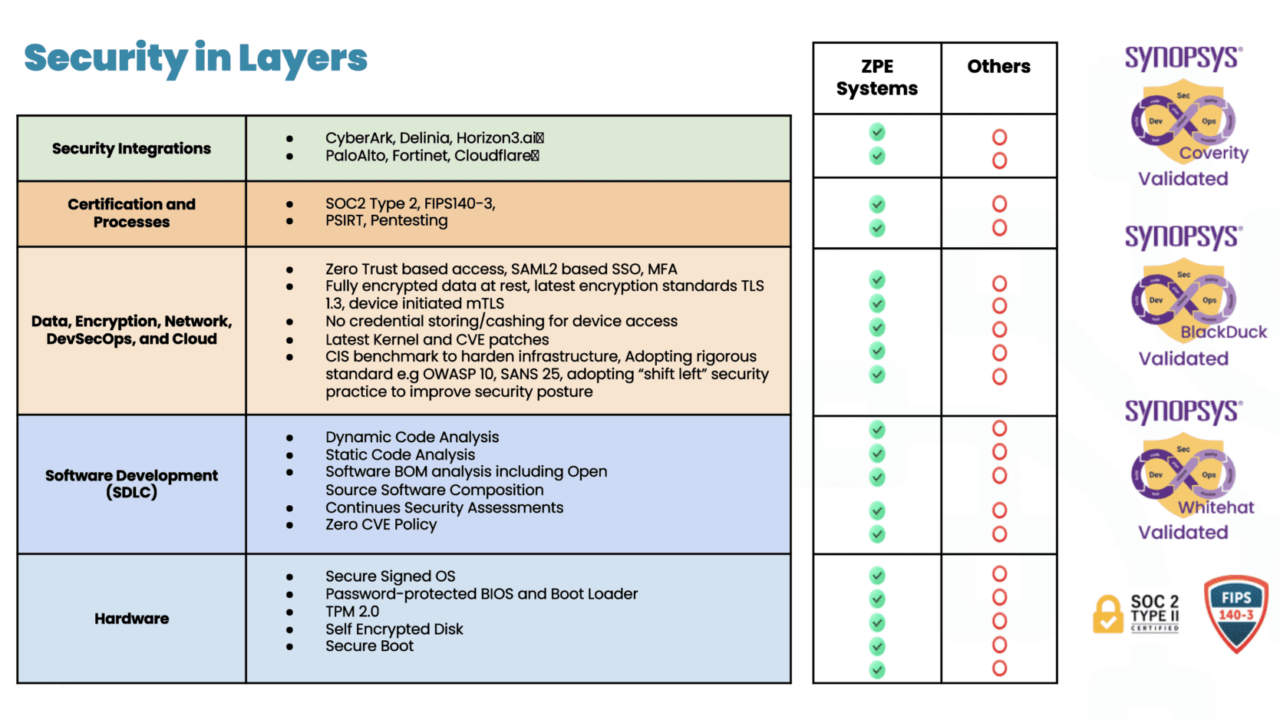
ZPE Systems’ Nodegrid is the industry’s most secure out-of-band management solution. Not only does the Nodegrid carry FIPS 140-3, SOC 2 Type 2, and ISO27001 certifications, but it also features a Synopsys-validated codebase and dozens of security features spanning the hardware, software, and cloud layers. All of these are part of a multi-layered, secure-by-design approach that ensures the strongest physical and cyber safeguards.
Download the Nodegrid PDF to explore more about its security assurance.
Frequently Asked Questions
What’s the difference between FIPS 140-2 and FIPS 140-3?
FIPS 140-3, released in 2019, replaced FIPS 140-2 with updated security requirements reflecting modern threats and cryptographic practices. The main differences include stricter requirements for entropy sources, enhanced testing protocols, and better alignment with international standards like ISO/IEC 19790. Organizations using FIPS 140-2 certified modules should plan migrations to FIPS 140-3, as NIST ended support for FIPS 140-2 in September 2019.
Do we need FIPS 140-3 certification for our data centre in Singapore?
While FIPS 140-3 is a US government standard, it’s increasingly required by multinational organizations and cloud providers operating in Singapore and APAC regions due to their global compliance frameworks. Many financial institutions, government contractors, and enterprise clients mandate FIPS 140-3 certification regardless of data centre location. Check your contracts and regulatory requirements—MAS, CSA, and PDPA guidelines may intersect with FIPS 140-3 needs for organizations handling sensitive cross-border data.
What does FIPS 140-3 Level 3 actually protect against that Level 2 doesn’t?
Level 3 adds tamper-resistance and identity-based user authentication, protecting against physical attacks and unauthorized access attempts in ways Level 2 cannot. While Level 2 requires tamper-evident measures (you know something was breached), Level 3 actively resists tampering and forces cryptographic module shutdown if intrusion is detected. Level 3 is suitable for environments with moderate physical security concerns, whereas Level 2 works for facilities with controlled access.
How long does FIPS 140-3 certification take and what’s the process?
FIPS 140-3 certification typically takes 12-24 months depending on module complexity and whether the cryptographic module is new or an iteration of a previously certified solution. The process involves submitting detailed security documentation, undergoing independent testing by NIST-accredited labs, and remediating any identified vulnerabilities. Vendors should budget for lab fees (often $50,000-$200,000+) and dedicate internal resources to work with testing laboratories throughout the evaluation.
Can we use FIPS 140-3 Level 1 for production data centre infrastructure?
Level 1 is generally not recommended for production data centre environments handling sensitive data, as it only establishes basic encryption without tamper resistance or advanced access controls. Most enterprise and regulatory frameworks expect at minimum Level 2 (with tamper-evident features and role-based access), while critical infrastructure and high-security environments should target Level 3 or Level 4. Level 1 may suffice for low-risk use cases or development environments only.
Which major cloud and hardware vendors have FIPS 140-3 certified modules?
Major vendors including AWS, Microsoft Azure, Google Cloud, Thales, Fortanix, and Yubico have FIPS 140-3 certified cryptographic modules for various use cases (HSMs, key management, encryption appliances). The NIST Cryptographic Module Validation Program (CMVP) maintains an official list of certified modules organized by validation number and implementation type. When selecting vendors, verify the specific module version and validation date, as certifications apply to individual implementations, not entire product lines.

Published by
eNOVA Technologies is Singapore's specialist distributor for data centre IT management solutions, representing Adder, Guntermann & Drunck, Raritan, Sunbird, ZPE Systems, and VuWall across Singapore and Southeast Asia. Our technical content is produced with AI assistance and reviewed by our in-house team before publication.
This article was produced with AI assistance and reviewed by the eNOVA Technologies team. All technical claims are verified against manufacturer documentation.